Battery C Rating Explained: Why Fast Charging Isn’t Just About Speed
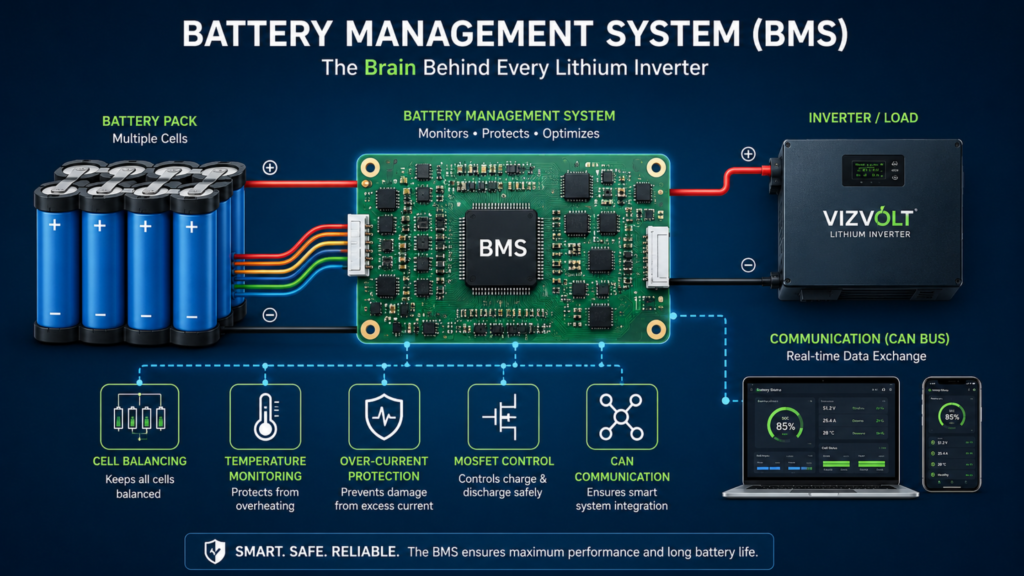
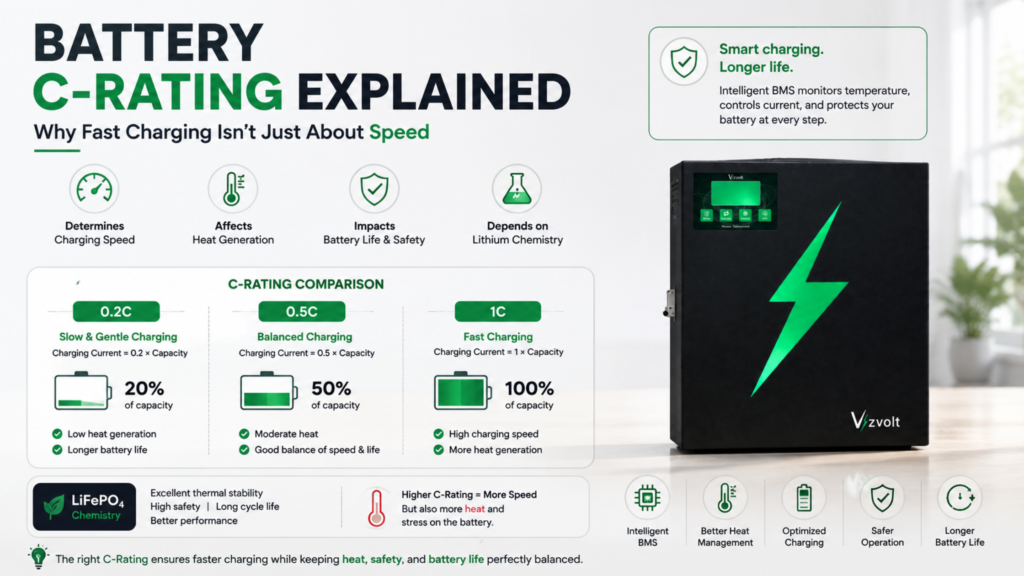
When buying a lithium inverter, most people compare battery capacity, backup time, charging speed, or warranty. While these specifications are important, there’s another technical parameter that plays a major role in battery performance-Battery C Rating. The Battery C Rating determines how quickly a battery can be safely charged or discharged. It affects charging time, heat generation, efficiency, battery lifespan, and overall reliability. Many people assume that faster charging is always better. However, from an engineering perspective, charging speed must always be balanced with battery chemistry and thermal management. A battery that charges extremely fast without proper control can generate excess heat and experience faster degradation. In this guide, we’ll explain what Battery C Rating means, how 0.2C, 0.5C, and 1C charging rates differ, and why understanding this specification helps you choose a smarter lithium inverter. What is Battery C Rating? The Battery C Rating indicates how quickly a battery can be charged or discharged relative to its total capacity. Instead of measuring charging speed in hours, engineers use C-Rating because it provides a universal way to describe battery performance regardless of battery size. Think of it as the battery’s “speed limit.” A higher Battery C Rating means the battery can safely accept or deliver more current in less time. For example: This specification is widely used in lithium batteries because it helps balance charging speed, efficiency, and battery life. How is Battery C Rating Calculated? The calculation is straightforward. Charging Current = Battery Capacity × C Rating Let’s take a 100 Ah lithium battery as an example. At 0.2C Charging Current100 Ah × 0.2 = 20 Amps At 0.5C Charging Current100 Ah × 0.5 = 50 Amps At 1C Charging Current100 Ah × 1 = 100 Amps As the Battery C Rating increases, the battery charges faster because more current is supplied. However, higher charging currents also increase electrical and thermal stress, which is why proper battery management becomes essential. Understanding 0.2C, 0.5C, and 1C Not every battery is designed to charge at the same speed. Let’s understand what these ratings mean in real-world applications. 0.2C Battery C Rating A 0.2C Battery C Rating means the battery is charged using current equal to 20% of its capacity. For a 100 Ah battery, that equals 20 A. Advantages Limitations Lead-acid batteries are commonly charged at lower C-rates because they are more sensitive to high charging currents. 0.5C Battery C Rating A 0.5C Battery C Rating is often considered a balanced charging rate. For a 100 Ah battery, charging current becomes 50 A. This offers a good compromise between charging speed and battery longevity. Advantages Many residential lithium energy storage systems operate efficiently around this charging range. 1C Battery C Rating A 1C Battery C Rating means the battery is charged using current equal to its full capacity. For a 100 Ah battery, the charging current is 100 A. In theory, this allows the battery to charge in approximately one hour. While this significantly reduces charging time, it also requires advanced thermal management, high-quality battery cells, and an intelligent Battery Management System (BMS). Not every battery is designed to safely operate at a 1C charging rate. Why Does Battery C Rating Matter? At first glance, Battery C Rating might seem like a specification meant only for engineers. In reality, it has a direct impact on everyday performance. A properly selected Battery C Rating influences: This is why manufacturers don’t simply aim for the fastest possible charging speed. Instead, they select a charging rate that provides the best balance between performance and long-term durability. Does a Higher Battery C Rating Always Mean Better Performance? Not necessarily. A higher Battery C Rating reduces charging time, but it also increases electrical current flowing through the battery. Higher current means: Modern lithium batteries are designed to handle these conditions far better than traditional battery technologies, but charging speed should always remain within the manufacturer’s recommended limits. This is why premium lithium backup systems focus not only on charging quickly but also on charging intelligently. For example, modern lithium inverters such as the Vizvolt Smart Lithium Inverter use an intelligent Battery Management System (BMS) to regulate charging current, monitor battery temperature, and optimize charging performance. Instead of simply charging as fast as possible, the system balances speed with battery health, helping extend service life while maintaining safe operation. Battery C Rating and Heat Generation One of the biggest misconceptions about fast charging is that it’s only about reducing charging time. In reality, every increase in charging current also increases heat generation inside the battery. Whenever electricity flows through a battery, a small amount of energy is naturally lost as heat due to the battery’s internal resistance. The higher the charging current (higher C-rating), the greater the heat produced. For example: If excessive heat isn’t properly managed, it can lead to: This is why premium lithium battery systems are engineered with intelligent Battery Management Systems (BMS) that continuously monitor battery temperature and automatically adjust charging current whenever necessary. Fast charging should never come at the cost of battery health. Battery C Rating and Lithium Chemistry Not all lithium batteries behave the same way. The battery’s chemistry plays a major role in determining how much charging current it can safely handle. Different lithium chemistries have different characteristics in terms of: Among them, Lithium Iron Phosphate (LiFePO₄) has become one of the most preferred chemistries for home energy storage. Why? Because LiFePO₄ batteries offer: These characteristics allow lithium inverters to support efficient charging while maintaining long-term battery reliability. Why Fast Charging Isn’t Just About Speed People often ask, “If a battery can charge faster, why not always use the highest charging rate?” The answer is simple: Charging speed is only one part of the equation. Engineers also consider: A well-designed lithium inverter doesn’t simply charge as quickly as possible-it charges intelligently. As the battery approaches full capacity, the charging current is gradually reduced to prevent overcharging and minimize stress on the cells. This charging strategy helps improve battery efficiency