Author name: Marketing Team

AI and Smart Monitoring
Blog

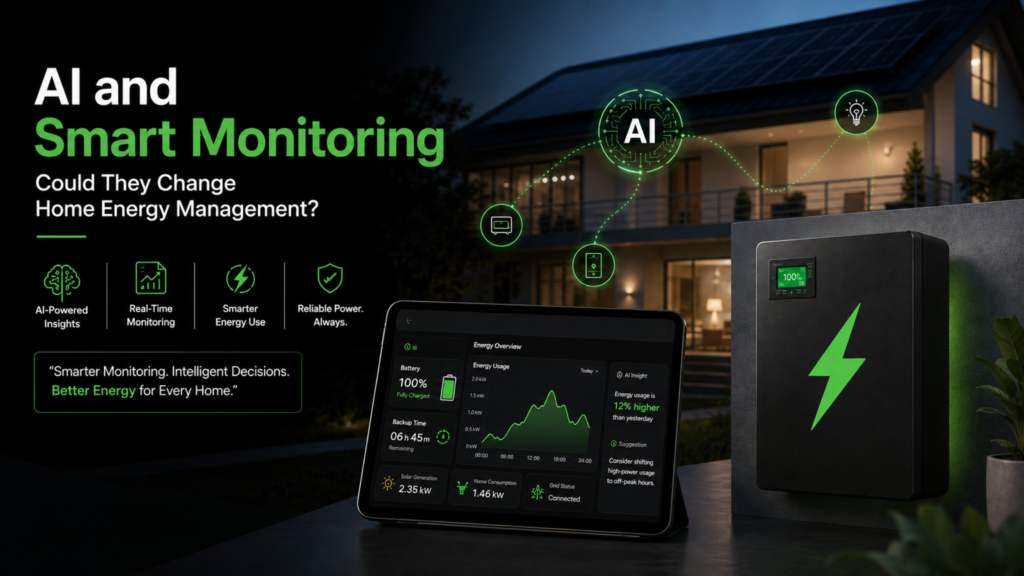
AI and Smart Monitoring: Could They Change Home Energy Management?

AI and Smart Monitoring could fundamentally change the way homeowners understand, manage, and use electricity. For most households, energy management is still largely reactive. The electricity is available, appliances are switched on, and the power bill arrives at the end of the month. If there is a power cut, the inverter takes over. If the battery begins to perform poorly, many homeowners discover the problem only when the backup time suddenly becomes shorter. This approach has worked for decades. But it provides very little visibility. Modern homes are now becoming more connected. We can monitor security cameras from our phones, receive alerts from smart appliances, track fitness data in real time, and control lights remotely. Energy systems are beginning to move in the same direction. With connected sensors, intelligent battery systems, smart inverters, cloud-based analytics, and artificial intelligence, homeowners may increasingly be able to understand not just how much electricity they are using, but also when they are using it, why their consumption is changing, and how their energy systems can perform more efficiently. That is where AI and Smart Monitoring become important. The future of home energy management may not simply involve producing or storing more electricity. It may involve using data to make better decisions about the electricity we already have. This shift has the potential to make home power systems more visible, more predictive, and eventually more responsive. However, the opportunity also comes with important questions about privacy, cybersecurity, reliability, and how much control homeowners should give to automated systems. So, could AI and Smart Monitoring really change home energy management? The answer is increasingly yes—but the transformation will depend on how intelligently these technologies are designed and implemented. What Is AI and Smart Monitoring in Home Energy Management? At its simplest, AI and Smart Monitoring combine two capabilities. The first is the ability to collect information. The second is the ability to analyse that information and potentially use it to improve decisions. Smart monitoring can involve connected sensors and digital systems that track information such as: Artificial intelligence can add another layer. Instead of simply displaying data, AI-based systems may analyse patterns and identify useful insights. For example, a monitoring system may show that a home’s electricity consumption increases every evening. An AI-based energy management system could potentially analyse that pattern and identify: The International Energy Agency explains that digital technologies can collect energy data through devices such as sensors and smart meters, while artificial intelligence algorithms can analyse that data and help enable real-world changes to energy use. That distinction is important. Monitoring tells you what is happening. AI can potentially help explain what may happen next. Together, they can move energy management beyond basic observation. Why Traditional Energy Management Is Becoming Outdated Traditional home energy systems were designed around a simple model. Electricity comes from the grid. Appliances consume it. A backup system provides power during an outage. The homeowner usually interacts with the system only when something goes wrong. But modern electricity consumption is becoming more complicated. Homes now contain: The number of connected and electricity-dependent devices is growing. At the same time, homeowners increasingly expect greater visibility. The IEA has highlighted how digitalisation can make energy systems more connected, intelligent, efficient, reliable, and sustainable, while also enabling more detailed monitoring of energy performance in buildings. The old approach of waiting for a monthly bill is therefore becoming less useful. Homeowners may increasingly want answers in real time. Questions such as: These are the kinds of questions that AI and Smart Monitoring could help answer. How AI and Smart Monitoring Work Together To understand the potential of AI and Smart Monitoring, imagine a simple chain. Step 1: Data Collection Connected devices collect information. For example: A smart inverter monitors battery voltage. A battery management system monitors temperature. A smart meter records electricity consumption. An IoT device measures appliance behaviour. Step 2: Data Transmission The information is sent to a local controller, mobile application, cloud platform, or energy management system. Step 3: Data Analysis Algorithms analyse the information. They may identify: Step 4: Insights The system converts raw numbers into useful information. Instead of showing only: Battery: 72% The system could eventually provide a more useful insight: “Battery usage is higher than your normal evening pattern.” Step 5: Action The homeowner receives information and decides what to do. In more advanced systems, some decisions could eventually be automated within predefined safety and user-control limits. This could include: The IEA notes that digital technologies can support greater control, optimisation, and analytics across energy systems, while connected devices can help improve the timing and efficiency of electricity consumption. 7 Powerful Ways AI and Smart Monitoring Could Change Home Energy Management 1. AI and Smart Monitoring Could Provide Real-Time Energy Visibility The first major change is visibility. Most homeowners do not have a detailed picture of what is happening inside their energy system at any particular moment. A smart monitoring platform can potentially display information such as: AI and Smart Monitoring could make this information easier to understand. Instead of requiring users to interpret complex electrical data, intelligent systems could translate information into practical insights. For example: “Your evening energy usage is 20% higher than your usual pattern.” Or: “Battery discharge is occurring faster than normal.” The goal is not to overwhelm homeowners with data. The goal is to make energy understandable. 2. AI and Smart Monitoring Could Make Energy Systems Predictive Traditional energy management is reactive. Something happens. Then the homeowner responds. AI introduces the possibility of prediction. By analysing historical patterns, an intelligent system may identify changes before they become major problems. For example, if a battery’s performance gradually changes over time, the system may detect a pattern that is not obvious to the user. Similarly, AI could analyse recurring energy behaviour. A system may learn that: A 2025 IEEE publication on AI and IoT for smart home energy management describes the use of real-time monitoring, predictive analytics, and AI-driven guidance to create more

Inverter Myths
Blog

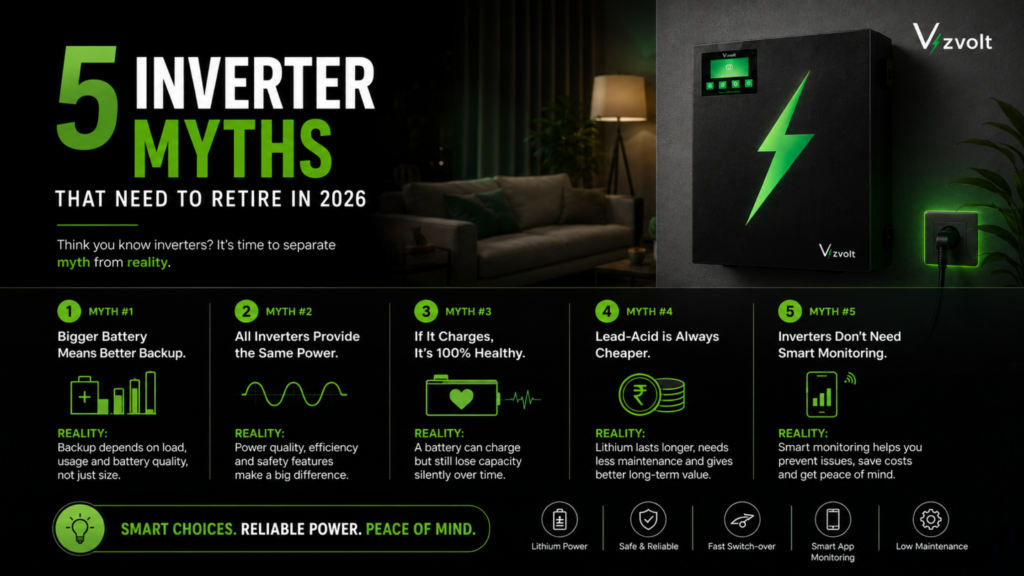
5 Inverter Myths You Need to Stop Believing in 2026: The Truth Revealed

Inverter myths have been passed from one generation of homeowners to another for decades. “Bigger battery means better backup.”“All inverters are basically the same.”“If the light is on, the battery must be healthy.”“Traditional batteries are cheaper, so they are always the better choice.” Most people have heard at least one of these statements. The problem is that many of them are based on old technology, incomplete information, or experiences with power backup systems that were designed for a very different lifestyle. In 2026, the way we use electricity at home has changed dramatically. Our homes now depend on Wi-Fi routers, laptops, smart TVs, security systems, mobile devices, workstations and connected appliances. During a power cut, backup power is no longer only about keeping one fan and a few lights running. It is increasingly about maintaining connectivity, comfort and continuity. This is why it is important to separate genuine technical information from outdated inverter myths. Modern power backup technology has evolved through better battery chemistry, smarter monitoring, improved power electronics and more compact system designs. Yet many buying decisions are still influenced by assumptions created years ago. In this article, we break down five common inverter myths that need to retire in 2026-and explain what homeowners should understand before choosing their next power backup system. Why Old Inverter Myths Still Exist Many inverter myths survive because traditional inverter systems were remarkably simple. For years, the typical setup consisted of an inverter connected to a large external battery. The battery charged when grid electricity was available and supplied power during an outage. Homeowners generally judged the system using only a few simple questions: That approach made sense when household electricity requirements were relatively basic. But today’s homes are different. A power interruption can disconnect an online meeting, restart a Wi-Fi router, interrupt a CCTV system or shut down a workstation. At the same time, users increasingly expect to understand what is happening inside their power system rather than simply waiting for it to fail. Modern battery storage and inverter technology have therefore become more intelligent. An inverter is fundamentally a power-electronics device that converts and controls electrical power, and modern systems can perform additional monitoring and communication functions depending on their design. Unfortunately, technology has moved faster than consumer awareness. That is why outdated inverter myths continue to influence how people compare products. Let’s look at the five biggest ones. Inverter Myth #1: Bigger Battery Always Means Better Backup This is one of the most common inverter myths. Many people assume that the largest battery automatically provides the best backup. The reality is more complicated. Battery Size Is Only One Part of Backup Time A battery stores energy, but backup time depends on how much power your connected appliances consume. For example, two homes may have identical battery capacities. One home may run: Another may run: The second home will generally consume stored energy faster. This means that battery capacity alone cannot tell you exactly how long your backup will last. You must also consider: Energy storage systems are commonly evaluated using both energy capacity, usually measured in kilowatt-hours (kWh), and power capacity, usually measured in kilowatts (kW). These two measurements describe different things. Energy Capacity Energy capacity tells you how much electrical energy can be stored. Power Capacity Power capacity tells you how much power the system can deliver at a given time. Both matter. This is why a larger battery is not automatically the right solution. The Better Question to Ask Instead of asking: “What is the biggest battery I can buy?”Ask: “What load do I actually need to support, and for how long?” This is one of the most important corrections to common inverter myths. The right power backup system should be matched to your actual lifestyle. A person working from home may prioritise: A family may prioritise: A small office may require: Buying unnecessary capacity can increase upfront cost. Buying insufficient capacity can lead to disappointing backup performance. The goal should not be the biggest battery.The goal should be the right energy system. Inverter Myth #2: All Inverters Provide the Same Quality of Power Another major inverter myth is the belief that every inverter produces essentially the same output. They do not. The quality of the electrical output can matter, particularly in homes filled with modern electronics. What Does an Inverter Actually Do? An inverter converts DC electricity from a battery into AC electricity that household appliances can use. Modern inverter systems use electronic switching and control systems to manage this conversion. The quality of the output waveform and the overall control system can influence how the inverter works with connected appliances. One important distinction homeowners may encounter is the type of waveform produced by the inverter. Pure Sine Wave A pure sine wave output is designed to closely resemble the smooth waveform supplied by standard AC electricity. It is generally preferred for modern electronic equipment and appliances because many devices are designed to operate using a stable sine-wave power supply. Modified or Lower-Quality Waveforms Some lower-cost systems may use different waveform technologies. The important point is not simply whether an inverter turns on. It is whether the system is designed to deliver suitable and stable power for the appliances you depend on. Why This Matters More in 2026 Older homes relied mainly on simple electrical loads. Today’s homes contain: These devices have increased the importance of power quality and system performance. The assumption that “an inverter is just an inverter” is therefore one of the inverter myths that deserves to disappear. What to Check Instead When comparing systems, look at: For example, VizVolt’s smart lithium inverter is designed with a pure sine-wave inverter and a switch-over time of less than 10 milliseconds, according to its product specifications. The lesson is simple: Do not compare only the price or the battery size. Compare the complete power system. Inverter Myth #3: If the Battery Charges, It Must Be Healthy This is one of the most dangerous inverter myths

Lithium adoption in modern home power systems
Blog

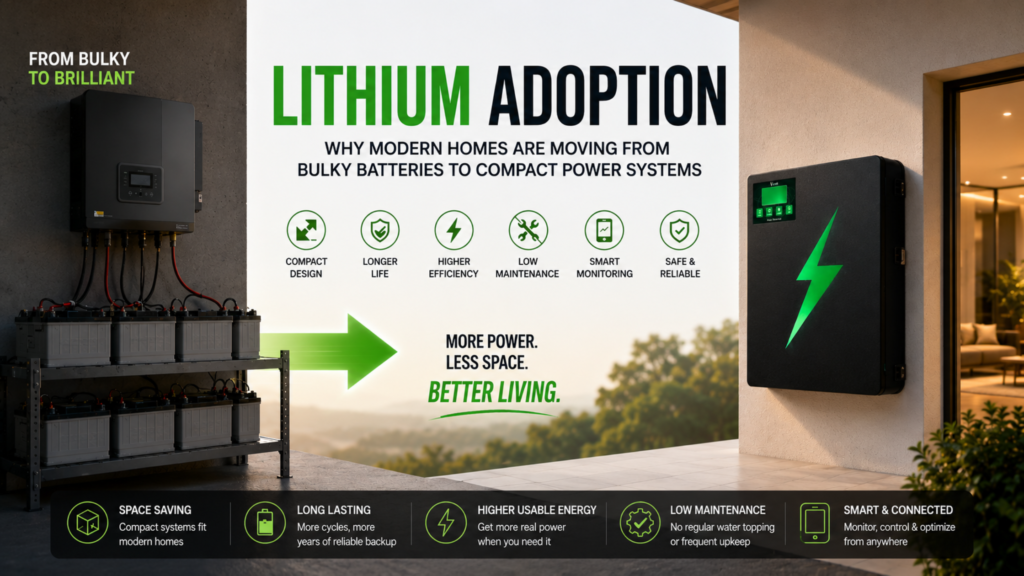
Lithium Adoption: Why Modern Homes Are Choosing Compact Power Systems

The growing demand for smaller, smarter, and more efficient backup systems is one of the key factors behind lithium adoption in residential energy storage. Lithium adoption is changing the way homeowners think about backup power. For decades, the typical home inverter setup meant a large battery, bulky installation, visible cables, regular maintenance, and a dedicated corner of the house. Backup power was treated as a necessary utility rather than something that could be compact, intelligent, and aesthetically integrated into modern living spaces. That is changing. As homes become smarter and more connected, homeowners increasingly expect their power backup systems to follow the same principles: compact design, better efficiency, minimal maintenance, intelligent monitoring, and reliable performance. This is where lithium battery technology has gained significant attention. According to the International Energy Agency, battery storage is currently one of the fastest-growing power technologies. In 2026 alone, 108 GW of new battery storage capacity was deployed globally, while lithium iron phosphate (LFP) batteries accounted for around 90% of deployments. The shift is not simply about replacing one battery chemistry with another. It represents a broader move toward smarter energy storage systems. Why Traditional Batteries Feel Bulky Traditional lead-acid batteries have played an important role in residential backup systems for decades. They are relatively straightforward, widely available, and familiar to consumers. However, they also come with characteristics that can make them less convenient for modern homes. A conventional setup may require: For a utility room or dedicated electrical area, this may not be a major concern. But modern homes are different. Apartments are increasingly space-conscious. Interiors are designed around clean lines and minimal clutter. Work-from-home setups occupy living spaces. Smart appliances and connected devices are becoming standard. A large battery sitting in a corner can therefore feel out of place.This changing lifestyle is one reason lithium adoption is gaining momentum. What Is Driving Lithium Adoption? There isn’t a single reason behind the growth of lithium-powered energy storage. Instead, several technological improvements have come together. The major drivers include: The IEA reports that lithium-ion batteries have benefited from major cost reductions, improved energy density, and longer lifetimes, helping them become a cornerstone of modern energy storage. This is why lithium adoption is occurring across several markets—not just residential backup. Lithium batteries are now widely used in electric vehicles, consumer electronics, commercial energy storage, UPS systems, and utility-scale battery storage. Lithium vs Lead-Acid: What’s Actually Different? The simplest way to understand lithium adoption is to compare lithium-ion technology with traditional lead-acid batteries. Feature Lithium Battery Lead-Acid Battery Energy Density Higher Lower Usable Capacity Generally higher Generally lower Charging Faster Slower Maintenance Low Higher, depending on type Weight Lower for equivalent energy Higher Cycle Life Generally longer Generally shorter Space Requirement More compact Larger Monitoring Advanced BMS possible Simpler systems Installation Flexibility Higher More limited The exact performance depends on the battery chemistry, design, operating conditions, and manufacturer specifications. However, the overall characteristics explain why lithium technology is increasingly attractive for energy storage. Compact Design: More Power in Less Space For space-conscious homeowners, lithium adoption offers a practical way to reduce the physical footprint of backup power equipment. One of the most visible advantages of lithium adoption is the reduction in physical footprint. Lithium-ion batteries generally have higher energy density than lead-acid batteries. That means more stored energy can be packaged into a smaller and lighter system. The IEA specifically notes that lithium-ion batteries have achieved higher energy densities than lead-acid batteries, enabling lighter and more compact battery packs. For homeowners, this translates into something very practical: More usable power without sacrificing as much space. Instead of designing a room around the battery, the battery system can be designed around the home. This makes compact lithium systems particularly attractive for: Longer Battery Life Battery replacement is one of the biggest considerations when calculating the long-term cost of a backup system. A battery isn’t useful simply because it stores energy today. It needs to maintain acceptable performance over repeated charge and discharge cycles. Lithium-ion technology can offer significantly longer cycle life than conventional lead-acid systems, although the exact number depends heavily on chemistry, operating conditions, depth of discharge, temperature, and system design. The U.S. Department of Energy’s energy-storage analysis reports lithium-ion cycle-life estimates across a broad range depending on technology and operating conditions, illustrating why manufacturers should not quote a single universal cycle number for every lithium battery. This is an important point for buyers. Battery chemistry matters, but battery engineering matters too. A well-designed battery management system, thermal control, charging strategy, and operating profile all influence real-world longevity. Higher Usable Energy Rated capacity and usable capacity are not necessarily the same thing. A battery may have a specified energy capacity, but operating it continuously at extreme states of charge can affect battery health and longevity. Lithium systems can generally operate across a wider usable range than traditional lead-acid systems, depending on the manufacturer’s specified depth-of-discharge limits. That means homeowners can potentially extract more useful energy from a lithium battery without requiring an unnecessarily large physical battery bank. This contributes directly to the appeal of lithium adoption. Instead of asking: “How large does my battery need to be?” Modern energy-storage design asks: “How much usable energy do I actually need, and how efficiently can the system deliver it?” Faster Charging Charging speed is another important reason for lithium adoption. Traditional lead-acid batteries can require significantly longer charging periods, particularly when they have been deeply discharged. Lithium batteries can generally accept higher charging rates, subject to the battery manufacturer’s specifications and the capabilities of the charging system. This becomes particularly useful when power interruptions occur frequently. Imagine a home experiencing several outages throughout the day. A system that can recover its charge faster is better positioned for the next interruption. For homes using solar generation, faster charging can also improve the ability to capture available solar energy during the generation window. Lower Maintenance One of the biggest lifestyle advantages of lithium adoption is reduced maintenance. Traditional flooded lead-acid

Lithium Inverter Safety Tips
Blog

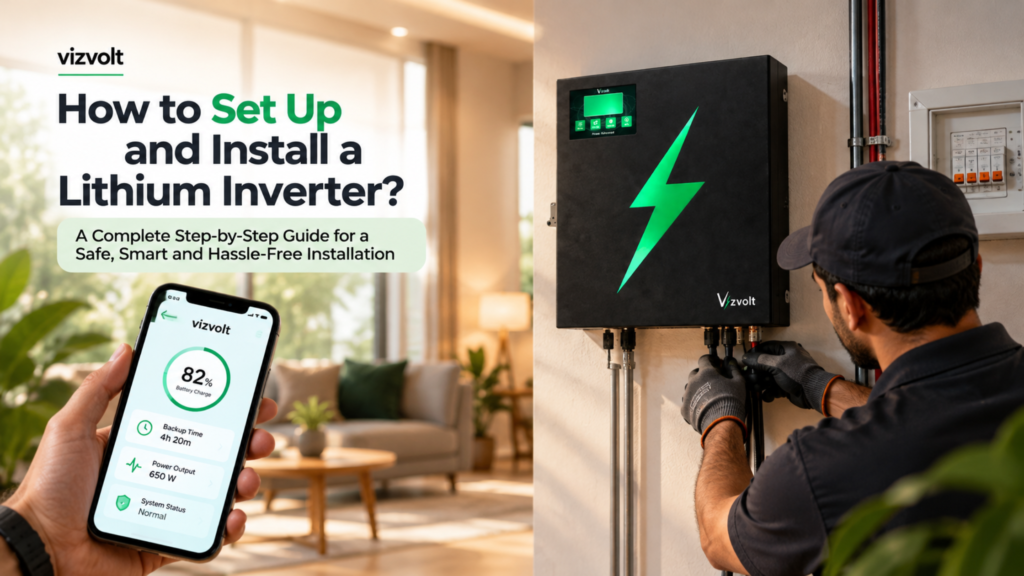
Lithium Inverter Safety Tips: A Complete Guide for Vizvolt Users

Lithium Inverter Safety Tips are becoming increasingly relevant as Indian homes move from conventional lead-acid inverter systems to modern lithium-powered solutions. Power backup has changed significantly over the last few years. The traditional inverter sitting beside a large battery is gradually making way for compact, wall-mounted and intelligent systems that can monitor their own battery conditions and provide information directly to the user. This shift brings several benefits. Lithium batteries can offer high energy density, compact installation, low routine maintenance and long service life. Smart inverter systems can also provide greater visibility into battery performance, load and system status. But advanced technology doesn’t eliminate the need for safe installation and responsible usage. In fact, as power systems become more intelligent, understanding how to use them correctly becomes even more important. For a system such as Vizvolt, safety is approached as part of the complete product architecture. Vizvolt combines an inbuilt LiFePO₄ battery, intelligent Battery Management System (BMS), Pure Sine Wave inverter, fast switch-over and IoT-enabled monitoring into a compact power-backup solution designed for modern homes. The objective isn’t simply to provide backup when the grid fails. It is to provide reliable, intelligent and controlled energy management while keeping the user informed about the condition of the system. In this guide, we’ll explore the most important lithium inverter safety practices and explain how they apply to a modern Vizvolt installation. Why Lithium Inverter Safety Tips Matter for Modern Homes Lithium batteries have become increasingly popular in residential power backup because they can offer a combination of compact size, high energy density, long service life and low routine maintenance. But lithium doesn’t mean users can ignore electrical safety. A modern lithium inverter should be treated as an engineered energy-storage system. Its battery needs to operate within appropriate electrical and temperature limits. The inverter needs to handle the connected load correctly. The installation needs appropriate protection and wiring. And the system needs to be used according to the manufacturer’s specifications. For Vizvolt users, this means understanding both the technology and the simple precautions that help maintain reliable operation. How Lithium Inverter Safety Works A modern lithium inverter typically involves several interconnected layers. Battery Stores electrical energy for use during backup. BMS Monitors and manages important battery parameters. Inverter Converts stored DC energy into AC electricity for connected appliances. Protection Systems Help manage abnormal electrical conditions. Monitoring Provides visibility into battery and system status. Installation Ensures the physical and electrical environment is suitable. All these layers work together. This is especially relevant to Vizvolt because the product is designed as an integrated smart system rather than simply a separate battery connected to a conventional inverter. 1. Lithium Inverter Safety Tips: Choose a Quality Lithium Inverter One of the most important Lithium Inverter Safety Tips is to start with a properly engineered system. Don’t compare lithium inverters only by: Look at the complete system. Important considerations include: A properly designed system uses multiple layers of protection instead of relying on one component. Vizvolt’s approach combines the lithium battery, intelligent BMS and inverter electronics into an integrated smart power solution. 2. Understand the Battery Management System The Battery Management System (BMS) is one of the most important components in a lithium battery. It acts as the intelligence and protection layer between the battery cells and the rest of the system. Depending on the system architecture, the BMS monitors parameters such as: Why does this matter? Lithium cells need to operate within defined electrical and thermal conditions. The BMS continuously monitors battery behaviour and can help protect the battery when abnormal conditions occur. This is why BMS quality can be more important than simply choosing a battery with a larger Ah rating. Vizvolt integrates an intelligent BMS into its smart lithium inverter architecture, providing both battery protection and useful information for monitoring. 3. Lithium Inverter Safety Tips: Professional Installation Even the best lithium inverter can become problematic if installed incorrectly. Professional installation helps ensure that: Vizvolt’s wall-mounted design helps create a cleaner installation than traditional floor-standing inverter and battery combinations. However, installation should still follow the manufacturer’s instructions and applicable electrical requirements. Never attempt internal electrical modifications yourself. 4. Lithium Inverter Safety Tips: Choosing the Right Location The installation environment has a direct impact on electrical equipment. Choose a location that is: Vizvolt’s compact wall-mounted form factor allows it to integrate naturally into modern interiors. But don’t sacrifice technical requirements for aesthetics. Avoid placing the inverter inside a tightly enclosed cabinet if that prevents the clearances or environmental conditions specified by the manufacturer. A beautiful installation should also be a technically correct installation. 5. Lithium Inverter Safety Tips: Keep Your Inverter Away From Water This is especially important during the monsoon season. An indoor inverter should still be protected from: Before monsoon arrives, inspect the area around your Vizvolt unit. Check the wall.Check the ceiling.Check nearby pipes.Check whether rainwater could potentially reach the inverter. If you notice water reaching electrical equipment, don’t touch exposed electrical connections. Follow appropriate electrical safety procedures and contact a qualified professional. 6. Lithium Inverter Safety Tips: Avoid Excessive Heat Temperature can affect battery performance and longevity. Avoid installing the inverter: The exact operating temperature range should always be taken from the product documentation. Vizvolt’s intelligent BMS provides battery monitoring, but good installation practices remain important. Smart technology adds protection. It does not replace responsible installation. 7. Lithium Inverter Safety Tips: Don’t Overload Your Inverter Every inverter has a rated output. For example, Vizvolt’s 1.1 kVA system is designed for a specified power range. This means homeowners should calculate the expected connected load before deciding which appliances will operate during backup. Common backup loads can include: High-power appliances can require substantially more energy. Examples include: Don’t judge the load simply by counting appliances. Instead, calculate their combined wattage and starting requirements. 8. Lithium Inverter Safety Tips: Never Modify the Electrical System This is one of the most important Lithium Inverter Safety Tips. Never attempt to bypass or modify the safety architecture of

Battery Capacity vs Efficiency comparison in a smart lithium inverter
Blog

Battery Capacity vs Efficiency: Which One Matters More?

When buying an inverter or battery backup system, most people immediately ask one question: “How much battery capacity does it have?” It’s a logical question because battery capacity determines how much energy can be stored. A larger battery generally means longer backup time. But here’s something many homeowners overlook. A battery with a larger capacity doesn’t always provide better real-world performance if the system isn’t efficient. This is where the debate around Battery Capacity vs Efficiency becomes important. Imagine two water tanks of the same size. One delivers almost all of the stored water with very little loss, while the other leaks continuously. Although both tanks have the same capacity, the usable water available is very different. The same principle applies to power backup systems. Battery capacity tells you how much energy can be stored, while efficiency determines how much of that stored energy can actually be used. Modern lithium inverter systems are designed to maximize both. Along with advanced battery chemistry, intelligent Battery Management Systems (BMS), Pure Sine Wave technology, and high-efficiency power electronics, today’s backup systems focus on delivering more usable energy—not just higher numbers on a specification sheet. Understanding Battery Capacity vs Efficiency helps homeowners make smarter purchasing decisions based on real engineering rather than marketing claims. In this guide, we’ll explain how battery capacity and efficiency work together, why both matter, and how choosing the right balance can improve backup performance, reduce energy losses, and provide greater long-term value. What Is Battery Capacity? Battery capacity refers to the amount of electrical energy a battery can store. It answers a simple question: “How much electricity is available inside the battery?” Battery capacity is commonly expressed using: The larger the capacity, the more energy the battery can potentially supply before it needs recharging. However, battery capacity alone does not determine actual backup time. Several other factors-including inverter efficiency, battery efficiency, appliance load, temperature, and Depth of Discharge (DoD)-also influence real-world performance. This is why understanding Battery Capacity vs Efficiency is essential before comparing different inverter systems. Understanding Ah, Wh, and kWh Many buyers see battery specifications like: but aren’t sure what these numbers actually mean. Let’s simplify them. Ampere-hour (Ah) Ampere-hour measures how much electric charge a battery can deliver over time. For example:A 100Ah battery can theoretically supply: under specified test conditions. However, Ah alone doesn’t tell the complete story because battery voltage also matters. Watt-hour (Wh) A more meaningful measure of stored energy is the Watt-hour (Wh). The formula is:mWh = Voltage × Ah For example:12.8V × 100Ah = 1,280Wh or 1.28 kWh This value represents the battery’s nominal stored energy. Kilowatt-hour (kWh) One kilowatt-hour equals: 1,000Wh Most residential lithium batteries specify capacity in kWh because it better represents usable stored energy. This makes comparisons easier when evaluating different backup systems. What Is Battery Efficiency? Battery efficiency describes how effectively stored electrical energy is delivered and recovered during charging and discharging. No battery system is 100% efficient. During operation, small energy losses occur due to: A more efficient battery system loses less energy and delivers more usable power to connected appliances. This is why Battery Capacity vs Efficiency should always be considered together. Two batteries with identical capacity can provide different real-world performance if their efficiencies differ. Different Types of Battery Efficiency Efficiency is not a single measurement. Instead, engineers evaluate several types of efficiency. Charging Efficiency Charging efficiency measures how effectively incoming electrical energy is stored inside the battery. Some energy is always lost as heat during charging. Higher charging efficiency means more of the supplied electricity becomes stored energy. Discharging Efficiency Discharging efficiency measures how effectively stored energy is delivered to connected appliances. Lower internal losses allow more usable energy to reach your devices. Round-Trip Efficiency One of the most important engineering measurements is Round-Trip Efficiency. It compares: Energy stored during charging versus Energy recovered during discharge. Higher round-trip efficiency means less energy is wasted throughout the complete charging and discharging cycle. This is particularly important in modern lithium energy storage systems where maximizing usable energy is a key design goal. Why People Often Confuse Battery Capacity with Efficiency One reason many buyers misunderstand Battery Capacity vs Efficiency is because battery advertisements usually highlight large capacity numbers. Statements such as: are easy to understand. Efficiency, however, is less visible. Yet efficiency directly affects: A larger battery with lower efficiency may not always outperform a smaller battery with better overall system efficiency. That is why engineers evaluate both specifications together. Capacity Tells You “How Much” Battery capacity answers: “How much energy can the battery store?” It determines the maximum available energy under specified conditions. For example: A battery rated at 1.28 kWh stores more energy than a battery rated at 0.64 kWh. That part is straightforward. Efficiency Tells You “How Well” Efficiency answers a different question: “How effectively is that stored energy used?” A highly efficient system: This is why modern lithium inverter systems focus on both battery capacity and system efficiency rather than increasing battery size alone. Why This Comparison Matters for Modern Homes Battery Capacity vs Efficiency is not about deciding that one specification is more important than the other. Instead, it helps homeowners understand how stored energy and system performance work together. Looking at Battery Capacity vs Efficiency as a complete engineering concept leads to smarter purchasing decisions and more realistic expectations from a modern inverter system. Today’s homes contain sensitive electronic equipment that depends on stable, efficient backup power. Examples include: For these applications, real-world performance depends on much more than battery capacity. System efficiency plays an equally important role in ensuring that stored energy is used intelligently and effectively. Understanding Battery Capacity vs Efficiency helps homeowners choose backup systems designed for modern living rather than simply comparing Ah ratings. Battery Capacity vs Efficiency: A Detailed Comparison Understanding Battery Capacity vs Efficiency becomes much easier when you compare how each factor influences the performance of your inverter system. While battery capacity determines the amount of energy stored, efficiency determines how

Lithium Inverter vs Normal Inverter comparison for modern homes
Blog

Lithium Inverter vs Normal Inverter: Which One Is Right for Your Home?

Choosing the right power backup system has become more important than ever. Modern homes depend on uninterrupted electricity to keep everything running-from Wi-Fi routers and laptops to smart TVs, refrigerators, CCTV cameras, and home office equipment. As technology continues to evolve, homeowners are often faced with one important question: Lithium Inverter vs Normal Inverter-which one should you choose? For many years, normal inverters paired with lead-acid batteries were the standard choice for residential power backup. They provided reliable backup during power cuts but required regular maintenance, occupied significant floor space, and often had a shorter service life. Today, lithium inverters are changing the way people think about backup power. With advanced LiFePO₄ battery technology, intelligent Battery Management Systems (BMS), fast charging, smart monitoring, and compact wall-mounted designs, lithium-based systems are becoming increasingly popular in modern homes and offices. However, choosing between the two isn’t just about selecting the latest technology. It requires understanding how they differ in terms of efficiency, battery life, maintenance, safety, installation, charging speed, long-term ownership costs, and overall user experience. This comprehensive guide compares Lithium Inverter vs Normal Inverter from an engineering perspective to help you make an informed decision based on your needs rather than marketing claims. Whether you’re replacing an old inverter or installing a new backup system, understanding these differences can help you invest in a solution that delivers reliable performance for years to come. What Is an Inverter? An inverter is an electrical device that converts Direct Current (DC) stored in a battery into Alternating Current (AC), allowing household appliances to operate during a power outage. When utility power fails, the inverter automatically switches to battery mode and supplies electricity to connected appliances. Once the grid power returns, the inverter switches back to mains supply and recharges the battery. Modern inverters do much more than simply provide backup power. Depending on their design, they can also: This evolution has given rise to intelligent lithium inverter systems. What Is a Normal Inverter? A normal inverter typically refers to a conventional inverter that works with a lead-acid battery. These systems have been used in homes for decades because of their relatively low initial cost and widespread availability. A traditional setup generally includes: Lead-acid batteries require periodic attention to maintain performance. Common maintenance tasks include: Although normal inverters continue to provide dependable backup for many households, they involve greater maintenance and occupy more installation space than modern lithium systems. What Is a Lithium Inverter? A lithium inverter combines a modern inverter with a LiFePO₄ (Lithium Iron Phosphate) battery and an intelligent Battery Management System (BMS). Unlike conventional systems, many lithium inverters are designed as compact all-in-one units where the inverter, battery, and management electronics are integrated into a single enclosure. A modern lithium inverter may include: These systems require significantly less maintenance and are designed to provide a cleaner, more user-friendly backup experience. Lithium Inverter vs Normal Inverter: Why Compare Lithium Inverter vs Normal Inverter? At first glance, both systems appear to perform the same function—they provide backup electricity during power outages. However, the technology behind them is fundamentally different. Comparing Lithium Inverter vs Normal Inverter helps homeowners understand differences in: Rather than choosing based solely on price, buyers should evaluate the overall value each technology offers throughout its lifespan. Lithium Inverter vs Normal Inverter: The Evolution of Home Power Backup Power backup technology has evolved considerably over the years. First Generation: Basic Inverters Early inverter systems focused on providing emergency electricity. Features were limited to: Second Generation: Improved Efficiency Manufacturers gradually introduced: These systems improved reliability but still depended largely on conventional lead-acid batteries. Third Generation: Smart Lithium Inverters Today’s lithium systems combine advanced battery technology with intelligent electronics. Modern features include: Instead of functioning as standalone backup devices, these systems become part of the connected home ecosystem. Lithium Inverter vs Normal Inverter: Understanding Battery Technologies The biggest difference in the Lithium Inverter vs Normal Inverter comparison lies in the battery technology itself. Lead-Acid Batteries Lead-acid batteries have powered backup systems for many years. Characteristics include: They continue to be used in many applications where budget is the primary consideration. LiFePO₄ Lithium Batteries LiFePO₄ batteries represent one of the most advanced battery chemistries used in residential energy storage. Compared with conventional lead-acid batteries, they generally offer: These characteristics have made lithium technology increasingly popular in modern homes and businesses. Why Modern Homes Are Moving Toward Lithium Today’s households use far more sensitive electronic devices than ever before. A typical home now includes: These devices benefit from cleaner, more stable backup power and intelligent battery management. As a result, many homeowners are moving toward lithium-based systems that combine compact design, advanced protection, and smart monitoring. Traditional Thinking vs Modern Energy Management For many years, buyers selected an inverter based primarily on battery capacity. Questions usually focused on: Modern buyers are asking different questions. They now consider: This shift reflects the transition from conventional backup systems to intelligent energy management solutions. Detailed Comparison: Lithium Inverter vs Normal Inverter Now that we’ve understood how both technologies work, it’s time to compare Lithium Inverter vs Normal Inverter feature by feature. Although both systems provide backup electricity during power cuts, their performance, maintenance requirements, efficiency, and overall ownership experience are quite different. Let’s examine the key differences. 1.Battery Technology The biggest difference in Lithium Inverter vs Normal Inverter is the battery itself. A normal inverter generally uses a lead-acid battery, while a lithium inverter uses a LiFePO₄ (Lithium Iron Phosphate) battery. Lead-Acid Battery Lead-acid technology has powered home backup systems for decades. Advantages include: However, lead-acid batteries require periodic maintenance and have lower energy density compared to lithium batteries. LiFePO₄ Battery Lithium Iron Phosphate batteries represent a newer generation of energy storage. Key characteristics include: This technology enables manufacturers to design smaller, lighter, and more intelligent backup systems. 2.Charging Speed Charging time is another major factor when comparing Lithium Inverter vs Normal Inverter. Normal Inverter Lead-acid batteries generally require several hours to recharge after a discharge cycle. Charging

Smart Inverter with intelligent BMS and IoT monitoring
Blog

Smart Inverter: More Than Just Backup Power

A Smart Inverter is no longer just a device that turns on during a power cut. Modern homes, offices, and businesses depend on uninterrupted electricity to power everything from Wi-Fi routers and laptops to smart TVs, CCTV systems, and connected home devices. As our dependence on technology grows, so do our expectations from a power backup system. Traditional inverters were designed with one primary purpose-to provide electricity when the utility supply failed. While they successfully performed that role, they offered little visibility into battery health, system performance, or energy consumption. Users often had to rely on simple LED indicators or audible alarms to understand the condition of their power backup system. Today’s Smart Inverter is fundamentally different. Powered by advanced electronics, intelligent Battery Management Systems (BMS), IoT connectivity, mobile applications, and real-time monitoring, a Smart Inverter becomes an intelligent energy management system rather than just a backup power device. It doesn’t simply store and deliver energy—it continuously monitors, protects, optimizes, and communicates how that energy is being used. This shift represents one of the biggest advancements in residential power backup technology over the past decade. In this guide, we’ll explore what makes a Smart Inverter truly “smart,” the engineering behind its intelligent features, and why choosing the right system is about much more than battery capacity or inverter wattage. What Is a Smart Inverter? A Smart Inverter is an advanced power backup system that combines intelligent software, power electronics, battery management, and connectivity to provide safer, more efficient, and easier-to-manage backup power. Unlike conventional inverters that only switch to battery mode during a power failure, a Smart Inverter actively monitors system conditions in real time. Depending on its design, a Smart Inverter may provide features such as: Together, these features allow users to better understand and manage their backup power system. From Traditional Inverters to Smart Inverters Power backup technology has evolved significantly over the years. Traditional Inverters Earlier inverter systems focused mainly on supplying backup power during outages. They typically offered: Although these systems were effective for basic backup needs, they lacked the intelligence required for today’s connected homes. Modern Smart Inverters A Smart Inverter goes much further by integrating hardware and software into one intelligent ecosystem. Instead of waiting for users to identify problems, the inverter continuously monitors system health and can provide useful information through a mobile application or display. Modern Smart Inverters are designed to: Rather than functioning as a standalone appliance, a Smart Inverter becomes part of a connected home energy system. Why Today’s Homes Need a Smart Inverter Modern households use significantly more sensitive electronics than they did just a few years ago. A typical home may include: Many of these devices rely on uninterrupted, stable electricity to function correctly. Even a brief power interruption can result in: A Smart Inverter is designed to address these modern requirements by combining reliable backup power with intelligent control and monitoring features. More Than Backup: Intelligent Energy Management The biggest difference between a traditional inverter and a Smart Inverter is intelligence. Instead of simply delivering battery power during an outage, a Smart Inverter continuously evaluates the entire power system. It monitors parameters such as: This information helps the inverter make more informed decisions about charging, protection, and battery operation. The result is a smarter, safer, and more efficient backup system. Why Engineering Matters More Than Marketing Many manufacturers advertise terms like: However, a true Smart Inverter is defined by engineering—not marketing terminology. Its intelligence comes from technologies working together, including: The quality of these components determines how effectively the system performs in real-world conditions. The Role of Software in a Smart Inverter Modern power backup systems are no longer controlled only by hardware. Embedded software now plays a critical role in system performance. Software helps a Smart Inverter: This combination of hardware and software transforms a conventional inverter into an intelligent energy management platform. Smart Inverter vs Conventional Inverter Feature Traditional Inverter Smart Inverter Battery Monitoring Basic Real-Time Mobile App No Yes IoT Connectivity No Yes Battery Management Limited Intelligent BMS Charging Basic Smart Adaptive Charging Diagnostics Minimal Advanced User Notifications No Yes Power Monitoring Limited Real-Time Firmware Intelligence Minimal Advanced User Experience Basic Connected & Intelligent Why Smart Inverters Are the Future As homes become increasingly digital, power backup systems must evolve beyond simply storing electricity. Future-ready backup systems should offer: A Smart Inverter is designed to meet these expectations by combining advanced electronics with intelligent software and modern connectivity. Instead of being just an emergency backup device, it becomes an active part of your home’s energy infrastructure. Intelligent Battery Management System (BMS): The Brain of a Smart Inverter The most important component inside a Smart Inverter isn’t the battery or even the inverter itself—it’s the Battery Management System (BMS). Think of the BMS as the brain of the entire energy storage system. While the battery stores electricity, the BMS continuously monitors, protects, and manages every aspect of battery operation to ensure safety, efficiency, and long-term reliability. A modern Smart Inverter equipped with an intelligent BMS can monitor: Instead of simply waiting for problems to occur, the system actively works to prevent them. This intelligence significantly improves battery life, performance, and overall system reliability. Why BMS Makes a Smart Inverter Truly Intelligent A conventional inverter only supplies backup power. A Smart Inverter continuously evaluates battery conditions. For example, if battery temperature rises unexpectedly, the BMS can automatically adjust charging behaviour or activate protection before the battery reaches unsafe conditions. Likewise, if one battery cell begins behaving differently from the others, the BMS detects the imbalance long before the user notices any issue. This continuous monitoring is one of the defining characteristics of a modern Smart Inverter. IoT Connectivity: Power Backup Meets the Internet One feature that truly differentiates a Smart Inverter from conventional systems is IoT (Internet of Things) connectivity. Instead of physically checking the inverter, homeowners can monitor their power system using a smartphone. The inverter securely communicates with cloud services and the VizVolt

BMS Quality in smart lithium battery system
Blog

BMS Quality: 7 Powerful Reasons It Matters More Than Battery Capacity

BMS Quality is one of the most overlooked factors when people compare lithium batteries and power backup systems. Most buyers immediately look at numbers such as 100Ah, 150Ah, 1.28kWh, or 2kWh and assume that the battery with the larger capacity must be the better choice. But capacity tells only part of the story. A lithium battery isn’t simply a container that stores electricity. It is an electrochemical system consisting of multiple cells that must continuously operate within safe voltage, current, and temperature limits. Managing those cells requires an intelligent electronic system known as a Battery Management System (BMS). A well-designed BMS continuously monitors the battery, controls charging and discharging, balances individual cells, detects abnormal conditions, and protects the battery when electrical or thermal parameters move outside safe limits. That means two batteries with the same capacity can deliver very different levels of safety, usable performance, reliability, and service life depending on their BMS Quality. For modern lithium inverter systems, therefore, the better question isn’t simply: “How big is the battery?” It is also: “How intelligently is that battery being managed?” This guide explains why BMS engineering can be more important than headline battery capacity and what homeowners should examine when choosing a modern lithium power backup system. What Is a Battery Management System (BMS)? A Battery Management System, commonly called a BMS, is an electronic control system responsible for monitoring and managing a rechargeable battery pack. Think of the battery cells as the energy-storage hardware and the BMS as the intelligence responsible for keeping that hardware within its intended operating conditions. Depending on the battery architecture and BMS design, it may monitor parameters such as: Advanced systems may also communicate battery information to the inverter or an IoT monitoring platform. This is one reason BMS Quality cannot be judged simply by whether a battery specification sheet says “BMS included.” Different BMS implementations can vary considerably in sensing accuracy, protection logic, balancing capability, communication, component quality, firmware, and overall engineering. Why Battery Capacity Alone Can Be Misleading Battery capacity is important. There is no question about that. However, it shouldn’t be considered in isolation. Suppose you compare two lithium batteries: Specification Battery A Battery B Rated Capacity 100Ah 100Ah Voltage 12.8V 12.8V Nominal Energy 1.28kWh 1.28kWh Chemistry LiFePO₄ LiFePO₄ On paper, they appear nearly identical. But Battery A may have accurate cell monitoring, good thermal sensing, reliable protection circuitry, appropriate cell balancing, and robust communication. Battery B may use a more basic BMS implementation. Their headline capacity is identical, yet their real-world behaviour can be different. This is why comparing batteries based solely on Ah or kWh can hide important engineering differences. 1.BMS Quality Helps Keep Every Cell Within Safe Limits A lithium battery pack consists of multiple individual cells connected together. These cells don’t always behave identically. Small differences can develop because of: A quality BMS monitors these conditions so the entire battery pack can operate within specified limits. This cell-level supervision matters because the overall battery voltage alone may not reveal the condition of every individual cell. For example, the total pack voltage might appear acceptable while one cell is approaching an undesirable voltage limit. Better BMS Quality allows the system to identify such conditions and respond appropriately. 2.BMS Quality Provides Overcharge Protection Charging a lithium battery isn’t simply a matter of supplying electricity until it is “full.” Charging must happen within defined voltage and current limits. If individual cells exceed their permitted upper voltage range, battery performance and longevity can be affected, and unsafe conditions may arise. A properly designed BMS continuously monitors cell voltage during charging. If a parameter exceeds its programmed limit, the system can intervene according to its protection strategy. This may involve: This is why the charging architecture and BMS must work together. A large battery without effective protection isn’t automatically a better battery. 3.Deep-Discharge Protection Preserves the Battery Overcharging isn’t the only condition that must be controlled. Lithium cells also have a minimum safe voltage. If a battery continues discharging beyond its intended lower voltage limit, excessive deep discharge can negatively affect cell health. A BMS monitors battery and cell voltage during discharge. When the battery approaches its lower operating threshold, the BMS can prevent further discharge according to the manufacturer’s protection design. This brings us to an important distinction: Rated capacity is not necessarily the same as usable capacity. A battery might be advertised as 1.28kWh, but how that energy is safely managed depends on the system design, allowed Depth of Discharge (DoD), efficiency, load, and BMS parameters. Good BMS Quality is therefore closely connected to how intelligently the available battery energy is used. 4.Temperature Monitoring Is Critical Lithium batteries are sensitive to temperature. Both charging and discharging performance can change significantly outside their intended temperature ranges. A high-quality BMS can use strategically placed temperature sensors to continuously monitor battery conditions. If temperatures move beyond configured operating limits, the system can take protective action. This becomes particularly important in environments where temperatures can vary substantially. Consider a battery installed in: The battery capacity may be impressive, but without proper temperature management and protection, the number on the specification sheet doesn’t tell the complete story. BMS Quality adds an important layer of thermal intelligence to the battery system. 5.Cell Balancing Improves Pack Consistency One of the most important jobs performed by a BMS is cell balancing. Imagine four cells connected together. Ideally, all four should charge and discharge in a closely matched manner. In reality, small differences gradually develop. For example: If one cell reaches its upper limit earlier than the others, charging may need to stop even though some cells have not reached the same state. Over many cycles, imbalance can influence how effectively the complete pack is used. Cell balancing is designed to reduce these differences. A well-engineered BMS can help maintain better consistency across the cells, supporting predictable performance over time. This is another reason BMS Quality matters more than simply choosing the highest Ah number available. 6.Current Protection

Inverter Switch Over Time protecting modern electronics during a power outage
Blog

Inverter Switch Over Time: Why Every Millisecond Matters During a Power Cut

When the electricity suddenly goes out, most people only notice the lights turning off. But behind the scenes, something far more important happens in just a few milliseconds. Your inverter detects the power failure, disconnects the utility supply, and begins delivering electricity from its battery. This brief interval is known as Inverter Switch Over Time, and it plays a critical role in determining whether your connected devices continue running smoothly or unexpectedly shut down. Modern homes rely on sensitive electronics such as computers, Wi-Fi routers, smart TVs, gaming consoles, CCTV systems, and network equipment. Unlike traditional appliances, these devices require a stable and uninterrupted power supply. Even a very short interruption can restart a computer, disconnect internet access, interrupt video calls, or corrupt unsaved work. This is why Inverter Switch Over Time has become one of the most important technical specifications in modern power backup systems. A faster switch-over ensures that power transitions seamlessly from the grid to the inverter, helping connected electronics continue operating without noticeable interruption. In this guide, we’ll explore what Inverter Switch Over Time actually means, why <10 ms has become an engineering benchmark, and how advanced lithium inverters are designed to support today’s increasingly digital lifestyles. What Is Inverter Switch Over Time? Inverter Switch Over Time is the time required for an inverter to transfer power from the utility grid to its battery when mains electricity fails. It is usually measured in milliseconds (ms).One millisecond is:0.001 second That means even a difference of a few milliseconds can determine whether your devices continue running normally or restart completely. For example: Switch Over Time Device Response <10 ms Most modern electronics continue operating smoothly 15–20 ms Some sensitive devices may restart 30 ms or more Higher likelihood of interruption Although these values seem incredibly small, modern electronics react extremely quickly to power interruptions. Why Switch Over Time Matters Years ago, homes mainly used electrical loads such as: These appliances were generally tolerant of short power interruptions. Today’s homes are different. A modern household may include: Many of these devices process digital information continuously. A brief interruption in power can cause: Because of this, Inverter Switch Over Time has become far more important than it was a decade ago. What Happens During a Power Cut? Understanding Inverter Switch Over Time becomes easier when we look at the sequence of events. Step 1 The utility grid supplies electricity to your home.All appliances receive normal AC power. Step 2 A power failure occurs.The incoming AC supply suddenly disappears. Step 3 The inverter immediately detects the loss of utility power.Its control electronics begin preparing battery power. Step 4 The inverter disconnects the utility input for safety. Step 5 The inverter starts producing AC output using battery energy. Step 6 Power reaches connected appliances again.The entire sequence happens in just a few milliseconds.The total duration between Step 2 and Step 6 is known as Inverter Switch Over Time. Understanding <10 ms Switching Many premium lithium inverters advertise: Switch Over Time: <10 msBut what does that actually mean? It means the inverter is capable of restoring backup power in less than ten milliseconds after detecting a power failure. Ten milliseconds equals:0.01 second For comparison: The transition occurs far faster than humans can perceive. However, electronic devices are much more sensitive than people. This is why a fast Inverter Switch Over Time is critical. Why Faster Is Better A shorter Inverter Switch Over Time offers several practical advantages. Improved Device Continuity Sensitive electronics experience little or no interruption. Better Productivity Computers remain powered during brief outages, reducing the chance of losing unsaved work. Reliable Internet Connectivity Routers and fiber modems are more likely to continue operating without restarting. Enhanced Smart Home Performance Home automation systems remain connected, allowing smart devices to continue functioning during power interruptions. Protection for Digital Equipment Many modern electronic products are designed around uninterrupted power operation. A fast Inverter Switch Over Time helps maintain stable operation during sudden grid failures. Why Milliseconds Matter More Than Ever Today’s homes contain far more digital electronics than traditional electrical loads. Consider a typical work-from-home environment. You may simultaneously use: A slow inverter might cause several of these devices to reboot after every power cut. A faster Inverter Switch Over Time minimizes these interruptions and provides a smoother backup experience. As remote work, online learning, cloud storage, and smart home technologies continue to grow, switch-over performance has become an increasingly valuable engineering specification—not just another number on a product brochure. Why Engineers Prioritize Switch Over Time When engineers evaluate inverter performance, they don’t focus only on battery capacity or power rating. They also examine: Together, these parameters determine how effectively an inverter supports sensitive electronic equipment during real-world operating conditions. A fast switch-over is therefore one of the defining characteristics of a modern, high-performance lithium inverter. Why SMPS Makes Inverter Switch Over Time So Important To understand why Inverter Switch Over Time matters, we first need to understand how most modern electronic devices receive power. Unlike older appliances, today’s electronics don’t run directly on AC power. Instead, they use an internal circuit called a Switched-Mode Power Supply (SMPS). You’ll find SMPS technology inside: These devices first convert AC electricity into DC power before supplying it to internal electronic components. Because of this design, they respond very differently to power interruptions than traditional electrical appliances. What Is an SMPS? A Switched-Mode Power Supply (SMPS) is a high-efficiency electronic power converter. Its primary functions include: Inside every SMPS is a capacitor bank that stores a small amount of electrical energy. This stored energy is often called hold-up energy. When utility power disappears, these capacitors continue supplying power for a very short period before becoming discharged. That brief energy reserve is exactly why Inverter Switch Over Time matters so much. Understanding Hold-Up Time Every SMPS has a characteristic known as Hold-Up Time. Hold-Up Time refers to how long the power supply can continue operating after input electricity disappears. Typical values are: Device Typical Hold-Up Time Desktop

Higher Ah Battery vs watt-hours explained
Blog

Higher Ah Battery: Does a Bigger Ah Rating Really Mean Longer Backup?

When comparing batteries for an inverter, one specification usually grabs everyone’s attention—the Ah (Ampere-hour) rating. Many buyers believe that a Higher Ah Battery automatically provides longer backup and is always the better choice. While that may sound logical, the reality is more complex. A battery’s backup performance doesn’t depend on Ah alone. Factors such as battery voltage, watt-hours (Wh), usable capacity, and Depth of Discharge (DoD) all play an equally important role in determining how long your appliances can actually run during a power outage. For example, a 100Ah battery doesn’t always deliver the same backup as another 100Ah battery. The battery voltage and the amount of usable energy available can significantly change real-world performance. Understanding these technical specifications helps homeowners make smarter buying decisions instead of relying solely on the Ah rating. In this guide, we’ll explain whether a Higher Ah Battery truly means better backup, how battery energy is actually calculated, and why electrical engineers focus on watt-hours rather than just Ampere-hours. What Is a Higher Ah Battery? Before comparing batteries, let’s understand what Ah actually means. Ah (Ampere-hour) measures a battery’s electrical charge capacity. In simple terms, it indicates how much electrical current a battery can supply over a certain period of time. For example: Because of this, many people assume a Higher Ah Battery automatically provides better backup. However, Ah tells only part of the story. It measures electrical charge—not the total amount of stored energy. Does Higher Ah Always Mean Better Battery Backup? The short answer is: Not always. A Higher Ah Battery generally stores more electrical charge than a lower Ah battery of the same voltage, but battery backup depends on several additional factors. These include: Ignoring these specifications can result in choosing a battery that appears larger on paper but doesn’t necessarily provide significantly longer backup. This is why professional battery comparisons rarely rely on Ah alone. Why Voltage Matters Voltage is one of the most overlooked battery specifications. Two batteries can have the same Ah rating while storing completely different amounts of energy. Consider these examples: Battery Voltage Capacity Battery A 12V 100Ah Battery B 24V 100Ah At first glance, both appear identical because each has a 100Ah rating. However, their stored energy is very different. Battery A: 12V × 100Ah = 1200Wh Battery B: 24V × 100Ah = 2400Wh Although both are 100Ah batteries, Battery B stores twice as much energy. This example clearly shows why a Higher Ah Battery isn’t enough information by itself. Voltage must always be considered. Understanding Watt-hours (Wh): The Real Measure of Stored Energy Electrical engineers prefer comparing batteries using Watt-hours (Wh) because it represents the battery’s total stored energy. The formula is simple: Battery Energy (Wh) = Voltage × Ah Let’s compare two batteries. Example 1 12V × 100Ah= 1200Wh Example 2 12.8V × 100Ah= 1280Wh Example 3 24V × 100Ah = 2400Wh Although all three batteries have the same Ah rating, their stored energy is different. This is why engineers focus on Wh (or kWh) instead of Ah when estimating backup time. Understanding this relationship helps buyers evaluate a Higher Ah Battery more accurately. Real-Life Comparison Imagine two homeowners purchasing batteries for their homes. Homeowner A Stored Energy: 12 × 150 = 1800Wh Homeowner B Stored Energy: 24 × 100 = 2400Wh Despite using a lower Ah battery, Homeowner B actually has more usable stored energy because of the higher system voltage. This demonstrates why comparing only Ah ratings can be misleading. When evaluating a Higher Ah Battery, always calculate the total energy stored rather than looking at the Ah value alone. Why Manufacturers Are Moving Toward kWh Ratings Modern lithium battery manufacturers increasingly specify capacity in Wh or kWh instead of only Ah. That’s because energy storage provides a more complete picture of battery performance. For example, a lithium battery rated at 1.28 kWh immediately tells you how much energy is available, regardless of battery voltage. This makes comparing different battery technologies much easier. Instead of asking: “Is this a Higher Ah Battery?” buyers should also ask: These questions lead to a much more accurate comparison. Why Ah Alone Can Be Misleading Many online marketplaces advertise batteries primarily by their Ah rating because it’s familiar to buyers. However, relying only on Ah can result in incorrect comparisons. Two batteries with identical Ah ratings may differ significantly in: Understanding these differences allows homeowners to choose a battery based on real performance rather than just a single specification. Usable Capacity: The Backup You Can Actually Use Many people assume that the total battery capacity is fully available during every power outage. In reality, that’s not how batteries work. Every battery has a usable capacity, which refers to the amount of stored energy that can safely be discharged without reducing battery life. This is where a Higher Ah Battery may not always provide better real-world performance. For example: Battery A Usable Capacity: 150Ah × 50% = 75Ah Battery B Usable Capacity: 100Ah × 90% = 90Ah Despite having a lower Ah rating, Battery B provides more usable energy. This example shows why choosing a Higher Ah Battery without considering usable capacity can be misleading. Depth of Discharge (DoD): A Critical Specification One of the biggest differences between battery technologies is Depth of Discharge (DoD). DoD indicates how much of the battery’s stored energy can safely be used before recharging. Typical values include: Battery Type Typical DoD Lead-Acid Around 50% AGM 50–60% Gel Battery 60–70% LiFePO₄ 80–100% (depending on system design) A battery with a higher DoD allows homeowners to use a greater percentage of its stored energy. This means a Higher Ah Battery with a lower DoD may actually provide less usable backup than a smaller lithium battery with a higher DoD. Engineering Perspective Electrical engineers rarely compare batteries using Ah alone. Instead, they evaluate: These parameters provide a much more accurate representation of real-world battery performance. For example: Battery A Battery Energy: 1800Wh Battery B Battery Energy: 2400Wh Although Battery B has a lower

Shopping Cart
Scroll to Top